Same Meal, Different History: A Long-Term Care Ombudsman Story

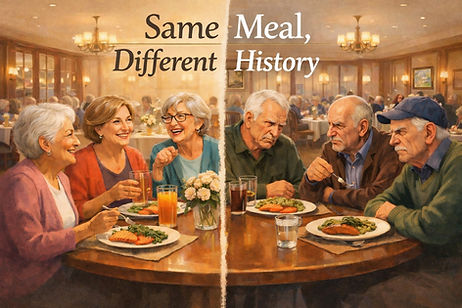
I was visiting an assisted living facility—the beautiful, expensive kind. The kind where many of the residents I meet are former physicians, attorneys, professors, accountants, and CEOs. They are educated, financially comfortable, and used to being listened to.
It was lunchtime.
I sat down at a table with four women studying their menus, each one tucked into a small wooden holder with food descriptions.
Salmon. Ravioli. Salads. Coke. Lemonade. Dessert.
Staff came by, took their orders, and later returned with beautifully plated meals, asking if they needed anything else. The women were delighted.
“It’s like being on a cruise ship,” one of them told me.
They talked about meeting in the dining room for meals, being served, and talking with friends. No grocery shopping. No deciding what’s for dinner. No chopping vegetables. No washing dishes.
They loved it.
They were relaxed, engaged, and grateful.
After finishing my visit, I scanned the room for another table.
More women.
Then I spotted a table of five men.
I thought I should talk to the men, too.
I walked over, introduced myself, and asked if I could sit down. One of them grunted something that sounded close enough to permission, so I pulled up a chair.
Two had been physicians—one an attorney. One had run a business. All accomplished men. All were accustomed to being in charge.
When they asked what I did, I explained that I’m a long-term care ombudsman.
One leaned forward.
“Have you ever actually solved a problem for someone?”
I smiled and gave him a few examples.
He frowned.
“Well, here’s one. The food is terrible.”
Immediately, four out of the five joined in.
“It’s not fit for human consumption.”“It’s always wrong.”“This isn’t fresh Atlantic salmon. It’s farm-raised.”
One man asked if his green beans were supposed to be cold. A server overheard and quickly brought him a fresh bowl, hot this time.
He kept eating.
Still complaining.
I asked, “Is it really that bad? Or is it just not your wife’s cooking?”
“It’s definitely not my wife’s cooking,” one of them said firmly. “And it’s bad.”
I asked if they attended resident council.
They waved me off.
“It’s a joke.”“Waste of time.”“Nothing ever changes.”
“It’s interesting,” I said. “All the women I’ve talked to today love the food.”
“That’s because they’re women,” one man snapped.
“I think they love it,” I said, “because they don’t have to cook it. And they don’t have to clean it up.”
Then, almost in unison, they said:
“Exactly.”
And that’s when I started laughing.
Because at sixty-four, I can absolutely see my husband at that table—criticizing the seasoning, the temperature, the preparation.
And I can just as clearly see myself at the women’s table, happy to order salmon, have it delivered, eat it, and walk away from the dishes without a second thought.
Same meal, different history.
For some, it’s the first time in decades they aren’t responsible for dinner.
For others, it’s the first time the cook isn’t someone who knows exactly how they like it.
I briefly considered visiting another table of women, then another of men, to see if there was a pattern.
But honestly, I had heard enough for one day.
As I walked out, I thought:
At sixty-four, tired of deciding what’s for dinner, I know exactly which table I’d choose.
To protect resident privacy, identifying details in this story have been changed. The situations described reflect real issues encountered in long-term care.


Comments